
Grow food where it cannot grow.
ATLA Systems builds food production modules: a whole growing environment inside a shipping container, run by software designed to measure everything and keep the climate steady, day and night.
AI-generated image
Food that depends on the weather is getting harder to grow.
In Korea, as in many places, the seasons decide what can be grown and when. A hotter summer, a short season or a closed border shows up on the shelf within weeks.
Summer is moving the fields
Summer napa cabbage comes from highland farms. Their area is forecast 17 % below normal in 2026.
A gap no one can import
Korea admits fresh strawberries only from Japan, and almost none arrive. From July to October, almost no fresh Korean strawberries reach the market.
Places with no fields at all
Desert cities, remote and polar stations, ships: fresh food travels a long way to reach them, or it does not come.
Sources: KREI agricultural outlook, Oct 2026; Plant Protection Act enforcement rules, annex 1; UN Comtrade, 2023.
The Food Production Module
An FPM is a self-contained farm in a 40 ft container. Light, climate, water and nutrients are all controlled inside it, so it is designed to work in any location with power.
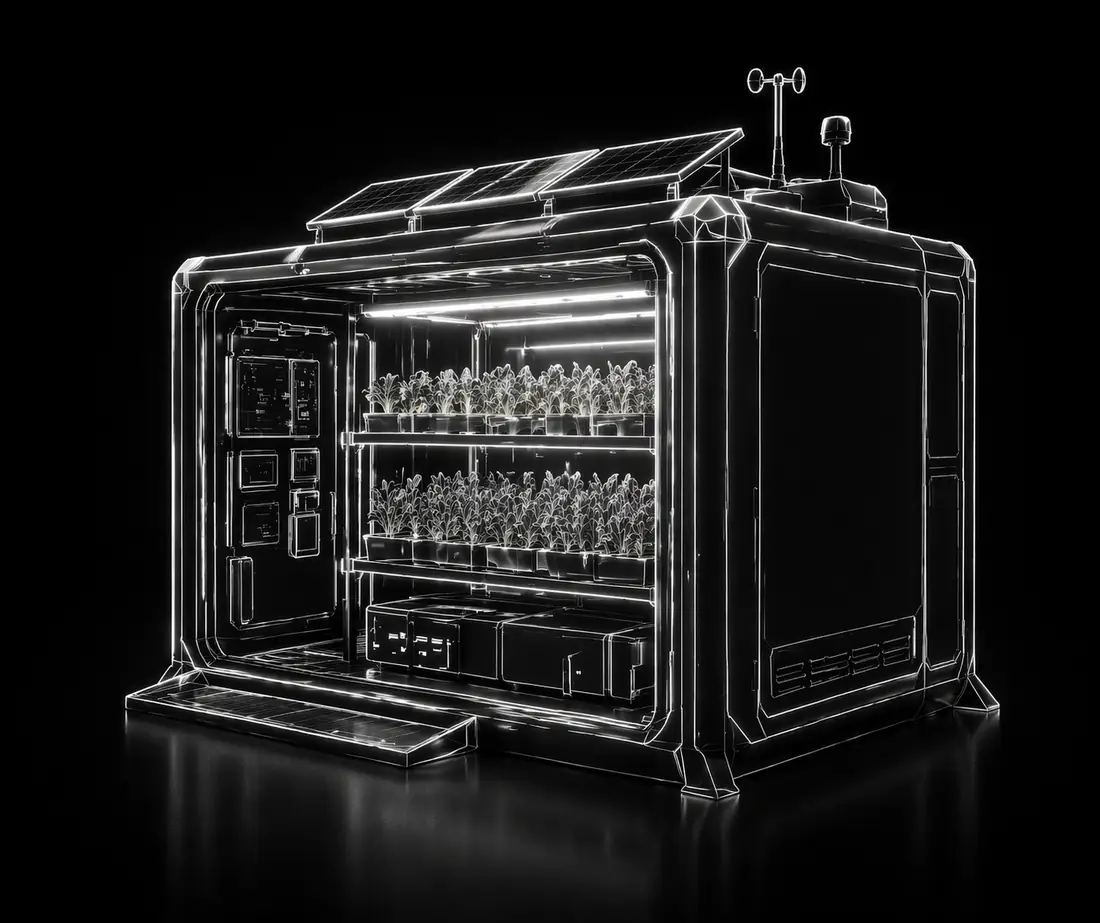
The whole cycle inside
Seed, growth and harvest all happen in the module. It is designed to need no field and no greenhouse next to it.
One module, one crop
Each module is designed to keep one climate and one nutrient circuit, tuned to the crop it grows.
Grow units by crop
Inside, grow units are chosen for the crop: tiered racks for strawberries, shallow drawers for leafy greens and herbs.
LED, climate, hydroponics, sensors
LED lighting, air handling, a recirculating hydroponic system and a full sensor set, designed to fit in one insulated container.
The FPM is built for any farm: growers, food companies, developers, and anyone who needs fresh food where fields cannot give it.
The module is in development. The pilot was run in a smaller indoor grow tent (see Progress).
Software that runs the farm
ATLA Systems is building one platform that connects data, environments and decisions: from the sensor in the water to the phone in your pocket.
Continuous data capture
Sensors read the nutrient water (pH, EC, dissolved oxygen, temperature), the air (temperature, humidity, CO₂) and the energy used, around the clock. In 2025 the pilot logged water pH, EC and temperature, air temperature and humidity, and energy use.
Control on the module
Each module gets its own industrial controller, designed to keep the climate and the water in range and to keep working if the network goes down.
Web, mobile and on-site panel
Web, Android and iOS apps and a panel on the module itself are planned, so you can follow every farm and every module and alarms reach the right person.
AI that advises
The AI we are developing studies each module's data and suggests better settings. It is designed to advise, never to drive the equipment: the controller and the grower stay in charge.
Encrypted remote access
Each module is reached through an encrypted connection; we do not use third-party analytics.
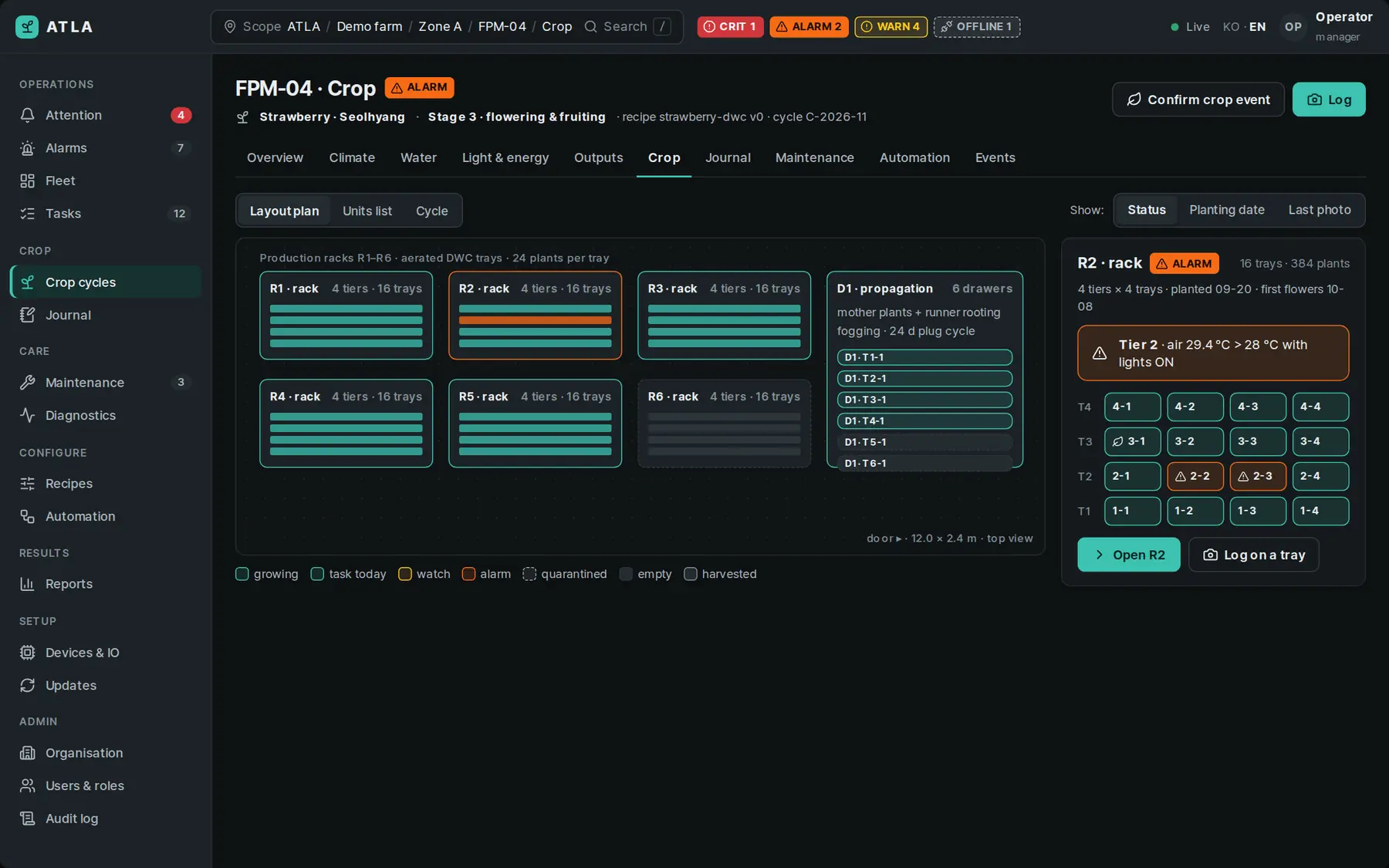
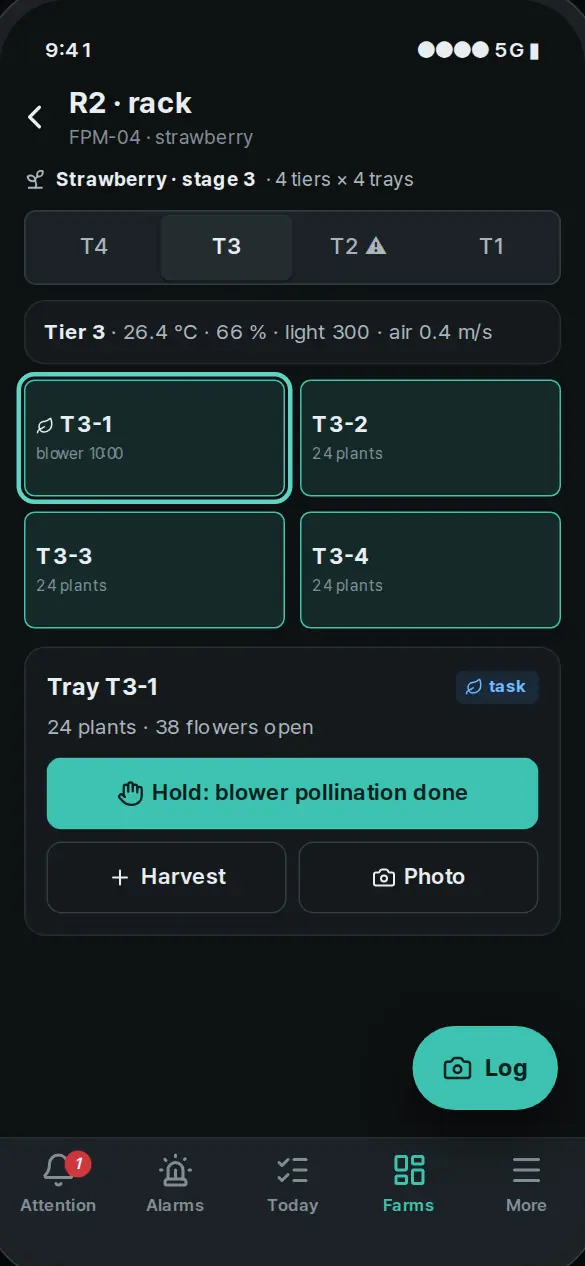
Screens of the platform in development. Illustrative data.
The platform is being rebuilt in 2026 on the experience of the pilot. This section describes the design of the new platform.
Crop programmes
We start with crops where a controlled module adds the most: high value, out of season, or hard to import. These are development programmes, not yet products on sale.
Off-season strawberry
Strawberries in summer and autumn, when Korean fields produce almost none.
Herbs
Fresh basil and culinary herbs, grown close to the kitchens that use them.
Netted melon (R&D)
Our first pilot crop, kept as a research programme.
Where we are
We prefer to show what we have done, not what we hope to do.
- 2025Pilot grow tent set up in Gyeonggi-do. First crop cycle and the first sensor and control software.
- Winter 2025/26Netted melons grown indoors under LED, from seed to netted fruit, in the middle of the Korean winter.
- 2026Platform rewrite: new controller, new server and new apps, built on what the pilot taught us. Crop programmes for strawberry and herbs.
What comes next
- 01
Platform
The new controller, server and apps running on the pilot.
- 02
First full-size module
A complete FPM in a 40 ft container.
- 03
Crop pilots
Strawberry and herb trials in the module, with measured results.
- 04
First partners
The first modules at partner sites: farms and food companies in Korea, then abroad.
Steps, not dates. We will add dates when we can keep them.
Team
Leads the design of the module and its software, and ran the pilot grow tent in Gyeonggi-do.
More of the team will be introduced soon.
Talk to us
Farms, food companies, developers and investors: tell us what you want to grow, and where.
Investors: our deck is available on request.